

When you hand over your practice's financial operations to an outside team, you're doing more than just hiring a billing company. You're engaging in outsourced revenue cycle management (RCM), a strategic partnership that lets you focus on patient care while experts handle the complex, often frustrating, world of medical billing and collections.
What Is Outsourced Revenue Cycle Management
Think of it this way: your practice is focused on one thing—delivering excellent patient care. That’s your race to win. But behind every great driver is a world-class pit crew, and that’s your outsourced revenue cycle management team. They handle the engine, the fuel, and all the complex mechanics that keep you on the track and moving forward.
While you're in the exam room, they're managing the entire financial journey for every patient. This process isn't a single task; it’s a continuous loop that starts the moment an appointment is booked and only ends when the final payment is successfully posted to your account.
The Core Stages of Outsourced RCM
A skilled RCM partner takes ownership of several crucial steps, each one feeding into the next. Getting these right is the key to preventing lost revenue and keeping your practice financially healthy.
- Patient Registration and Eligibility Verification: This is the first line of defense. Your partner confirms insurance coverage and patient details before the visit, stopping potential denials before they ever happen.
- Medical Coding and Charge Capture: Expert coders translate your clinical services into the universal language of medical codes. Their precision is what ensures you’re paid correctly for the work you do.
- Clean Claim Submission: The goal here is to submit error-free claims to payers on the very first try. A strong partner will consistently achieve a clean claim rate of over 98%, which means you get paid faster with far fewer headaches.
- Denial Management and Appeals: When a claim is denied, the fight isn't over. This is where an experienced team shines, digging into the reason for the denial, fixing the issue, and relentlessly appealing to recover the money you've earned.
- Accounts Receivable (A/R) Follow-Up: A good RCM team doesn't let unpaid claims sit idle. They actively pursue outstanding balances from both insurance companies and patients, driving down the number of days your money is tied up in A/R.
The flowchart below shows how all these pieces fit together. It’s a cycle where every stage impacts the next, which is why having one integrated team manage the whole process is so effective.
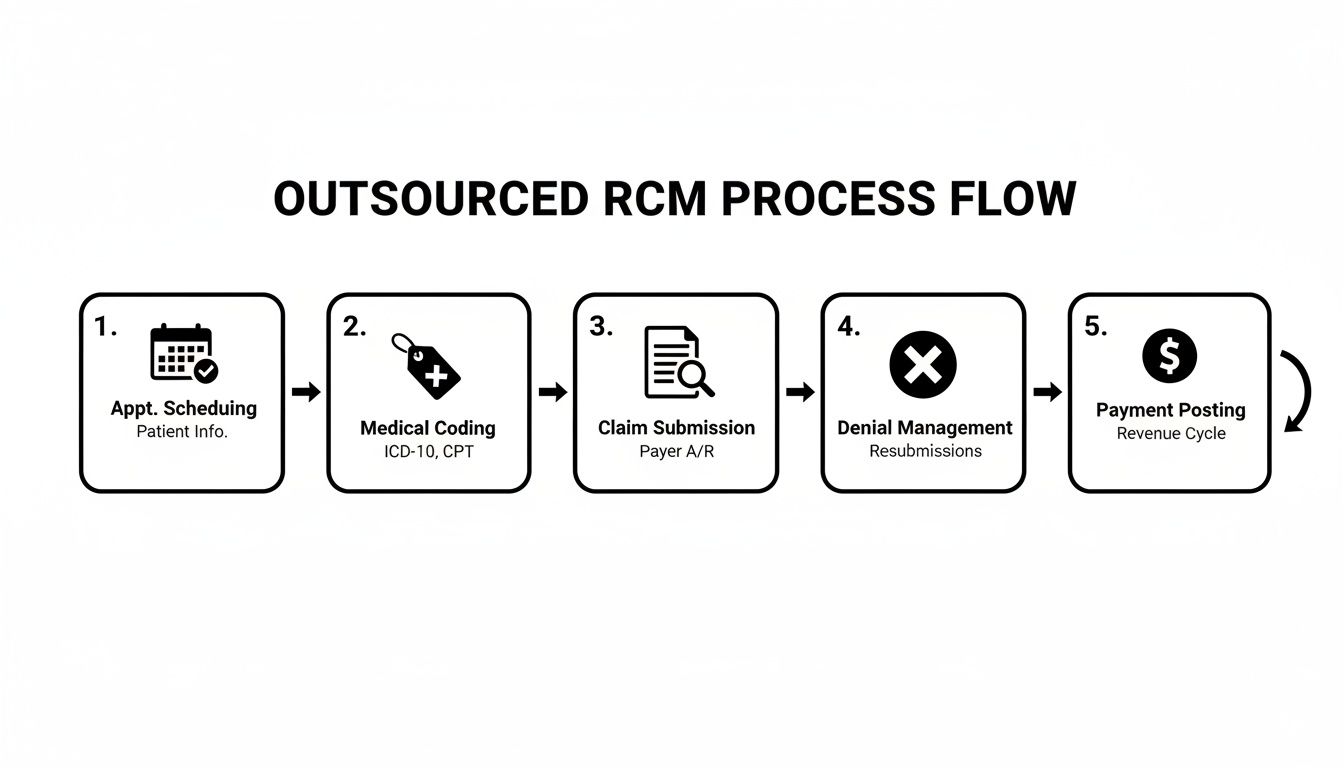
As you can see, it's a continuous loop. The end of one cycle—payment posting—provides the data and insights to improve the beginning of the next one.
A Growing Trend for Modern Practices
For many independent and specialty practices, trying to manage this entire complex process in-house is a recipe for staff burnout, climbing denial rates, and unpredictable cash flow. It’s no surprise that more and more practices are choosing to outsource.
The market for healthcare RCM outsourcing is exploding. It's expected to fly past $34 billion by 2025 and is on track to nearly double in the following four years. This isn't just a fad; it's a fundamental shift in how successful practices operate.
This massive adoption, especially here in North America, proves that practice leaders are realizing RCM isn't just back-office paperwork—it's a critical financial tool.
You can dive deeper into these trends in our other articles about revenue cycle management. By offloading this heavy operational burden, practices are turning a major headache into a source of financial strength, freeing them up to put all their energy where it belongs: with their patients.
Spotting the Warning Signs in Your Practice

The idea of bringing in outside help for your billing doesn't usually happen overnight. It’s more often a slow burn—a growing collection of nagging issues that signal something is fundamentally wrong with your practice’s financial health.
These aren't just minor headaches. They’re critical warning signs that your internal processes are leaking revenue and pulling focus away from patient care.
Think of it like a patient who comes in with a set of vague but chronic symptoms. A little fatigue here, a nagging cough there. Individually, they might not seem alarming, but together they point to an underlying condition that requires a specialist. The same is true for your revenue cycle.
Financial and Operational Symptoms
Is your front desk spending more time on hold with insurance companies than checking in patients? Does your cash flow swing wildly from one month to the next, making it impossible to plan for new equipment or staff bonuses? These are classic symptoms of a revenue cycle under strain.
Many practices get so used to these daily battles that they start to feel normal. They aren't. These problems are a major drag on your profitability, and they're often more fixable than you think. Some of the most common pain points we see include:
- Rising Claim Denials: Even a small jump in your denial rate can have a massive financial impact. What most practices don't realize is that an estimated 86% of claim denials are avoidable, but preventing them requires a level of focus that most in-house teams simply can't spare.
- An Increasing Days in Accounts Receivable (A/R): When it takes longer and longer to get paid for work you've already done, your cash flow dries up. This metric is a direct pulse check on your practice’s financial well-being.
- Staff Burnout and High Turnover: Your team is juggling complex billing rules, endless phone calls, and frustrating paperwork. This administrative overload tanks morale and takes them away from the work that truly matters—caring for patients. It's also a leading cause of expensive staff turnover.
A healthy revenue cycle isn't just about getting paid. It's about getting paid predictably and efficiently. When your internal team is stuck putting out fires, they are always one step behind. An outsourced revenue cycle management partner works ahead of the problems, stopping denials before they ever happen.
The Hidden Costs of In-House RCM
Beyond the obvious frustrations, there are hidden costs quietly eating away at your bottom line. These are the expenses and missed opportunities that don’t always appear on a spreadsheet but are just as damaging.
Running an in-house billing department means constantly investing in things that have nothing to do with medicine. You have to cover salaries and benefits, of course, but also ongoing training to keep up with constantly changing payer rules and coding updates. You’re also on the hook for expensive billing software, IT support, and the physical space for your billing staff.
But the biggest hidden cost? Distraction. Every hour a physician or practice manager spends untangling a billing mess, mediating a staff conflict over collections, or trying to decipher a new insurance policy is an hour not spent seeing patients or growing the practice.
The table below helps connect these common internal struggles to their real-world costs. More importantly, it shows how a dedicated outsourced partner provides a direct solution for each one.
In-House RCM Challenges vs Outsourced Solutions
This table helps practices identify common internal billing problems and shows how an outsourced RCM partner directly addresses them.
| Symptom in Your Practice | What It Costs You | How an Outsourced Partner Solves It |
|---|---|---|
| High Claim Denial Rate | Direct revenue loss, wasted staff time on appeals, and delayed cash flow. | Employs certified coders and advanced claim scrubbing tools to achieve a 98%+ clean claim rate. |
| Growing A/R and Slow Payments | Unpredictable revenue, difficulty budgeting, and writing off money that should be collectible. | Implements a disciplined, daily follow-up process on all outstanding claims to slash Days in A/R. |
| Staff Overwhelmed by Billing Tasks | Reduced focus on the patient experience, high employee turnover, and constant training expenses. | Takes on the entire billing workload, freeing your staff for higher-value, patient-facing roles. |
| Keeping Up with Payer & Coding Rules | Compliance risks, claim errors from outdated knowledge, and missed revenue opportunities. | Maintains a team of specialists whose entire job is to master industry regulations and coding changes. |
By offloading these complex and time-consuming tasks, you're not just fixing a few operational snags—you're repositioning your practice to focus on what it does best: providing excellent patient care.
The True Financial Impact of Outsourcing RCM

When practices start looking at outsourcing their revenue cycle, the conversation always comes down to one thing: return on investment. But it’s a mistake to think of it as just swapping one line item expense for another. What you’re really doing is changing the entire financial DNA of your practice—slashing costs immediately while also kicking your revenue growth into a higher gear.
The most obvious savings come from dropping the heavy overhead of an in-house billing team. Think about it. You’re not just paying salaries; you’re covering health insurance, retirement plans, and payroll taxes. On top of that, you have the costs of their office space, computers, and specialized billing software with its hefty annual license and support fees.
These are all fixed costs that weigh you down, month after month, regardless of how much you're actually collecting. Moving to an outsourced model converts that dead weight into a predictable, variable expense that rises and falls with your actual revenue.
Beyond Savings to Active Revenue Growth
Cutting costs is a great first step, but the real magic of a skilled outsourced revenue cycle management partner is their knack for bringing more money in the door. They don’t just work harder; they work smarter, applying a level of expertise that’s nearly impossible to replicate in-house.
This revenue boost typically comes from three key areas:
- Higher Clean Claim Rates: An expert partner has coders who live and breathe your specialty. They know the nuances and common tripwires, ensuring claims are right the first time. This cuts down on frustrating denials and gets you paid faster.
- Relentless A/R Follow-Up: A dedicated team has the time and the systems to chase down every single unpaid claim, no matter how small. They stay on top of aging reports, making sure money doesn’t just wither and die on the vine.
- Recovery of Old Balances: Many RCM partners kick off the relationship by attacking your old A/R backlog. They're often able to recover cash from claims you might have already written off, giving your practice a powerful, one-time cash infusion.
The results we see from this kind of focused effort are profound. It's common for practices to see reductions in billing-related expenses by up to 40%. At the same time, they often achieve an average increase in collections of 18%. That one-two punch of lower costs and higher revenue is the whole game.
This isn't just a niche trend; it's a major market shift. As patient volumes and operational headaches grow, more providers are outsourcing to keep their finances healthy. In fact, North America now accounts for a massive 55.26% share of the $163.72 billion global RCM market. For a deeper dive into what’s driving this, you can explore detailed revenue cycle management trends.
Reinvesting Your Gains Where They Matter Most
A healthier bottom line is fantastic, but the real question is what you do with that newfound financial freedom. The end goal isn't just to have a better-looking P&L statement; it's to turn those administrative savings and revenue gains into real-world improvements for your patients and your practice.
With more predictable cash flow, you can finally greenlight important projects that have been stuck on the back burner. This creates a virtuous cycle where financial health leads to better care, which in turn fuels more growth.
For instance, you could finally:
- Invest in Advanced Technology: Buy that new diagnostic machine you’ve been eyeing or upgrade your EHR to make everyone’s lives easier.
- Enhance Patient Care: Hire another MA to cut down on wait times or roll out that patient education program you've always wanted.
- Grow Your Practice: Open a small satellite office to serve a new community or add a complementary service line.
- Reward Your Team: Offer the competitive salaries and bonuses needed to keep your best clinical staff happy, reducing the high cost of turnover.
When you get your revenue cycle right, you aren't just plugging a leak in your finances. You're building a more resilient, growth-oriented practice. If you're looking for more ways to strengthen your financial position, you might find our other articles on improving your healthcare finance strategy helpful.
How to Choose the Right RCM Partner

Choosing an outsourced revenue cycle management partner is easily one of the most critical financial decisions your practice will ever make. This isn't just about hiring a service; it's about bringing on a partner who will function as a genuine extension of your team.
The right choice can unlock surprising revenue growth and give you back your operational freedom. The wrong one? It can create financial and administrative headaches far worse than the ones you were trying to solve in the first place.
This decision doesn't have to be a shot in the dark. By focusing on a few key areas, you can see past the sales pitches and evaluate potential RCM companies on what actually matters. This simple framework will help you confidently pick a partner that truly understands your practice's needs and supports your long-term vision.
Think of it this way: you wouldn’t hand over your life savings to a financial advisor without a serious background check. You'd want to know their track record, their communication style, and exactly how they make their money. Apply that same level of diligence here.
Evaluate Their Specialty-Specific Expertise
This is the big one. The single most important factor is whether a potential partner has deep, proven experience in your specific medical specialty. Healthcare billing is absolutely not a one-size-fits-all game.
The coding nuances, payer rules, and common denial traps for a dermatology practice are a world away from those for an oncology group or an orthopedic practice. A generalist RCM company that claims to "do it all" will never compete with a team that lives and breathes your specific corner of the medical world. Their lack of focused knowledge will inevitably show up as higher denial rates and lost revenue.
Get right to the point and ask some tough questions:
- Do you have certified coders who work only on my specialty?
- Can you show me anonymized performance data from practices that are the same size and specialty as mine?
- How, specifically, do you keep your team educated on the constant coding and reimbursement changes in my field?
Scrutinize the Pricing Model
Honest, transparent pricing is non-negotiable. The industry standard is a simple fee based on a percentage of collections—the money they actually put in your bank account. This is the best model because it aligns their goals with yours. They only get paid when you do.
Be very skeptical of any vendor that presents an overly complicated pricing sheet or tries to lock you into a flat monthly fee regardless of performance.
A clear, straightforward pricing structure is a sign of an honest partner. If a vendor can’t give you a simple answer on how they get paid, it’s a major red flag. Look for a clear percentage of collections with absolutely no hidden fees.
You should never have to pay for setup, implementation, or standard monthly reports. Get clarification on what their percentage fee covers. Are you going to get nickeled-and-dimed for things like sending patient statements or processing credit card payments? Get every single detail in writing before you even think about signing.
If you want to dig deeper, our guide on selecting an outsourced medical billing company offers more detailed advice on this topic.
Confirm Technology and EHR Integration
Your RCM partner’s technology has to play nicely with your existing Electronic Health Record (EHR) system. A clunky, disconnected workflow completely defeats the purpose and just creates more manual work for your staff. The integration needs to be seamless and secure, allowing for a smooth transfer of all the necessary patient data and clinical notes.
Insist on a live demonstration. Watch how their system connects with yours. Will your team be stuck doing manual data entry or uploading files? The best partners offer a solution that pulls information directly from your EHR to build and submit claims, requiring almost zero effort from your front desk.
Assess Communication and Reporting
When you outsource your billing, you aren't giving up control—you should be gaining more insight and visibility. A top-tier RCM partner will equip you with powerful, easy-to-read reports that give you a crystal-clear, real-time look at your practice's financial health.
Here’s what a great partnership looks like in terms of communication:
- A Dedicated Account Manager: You need one person who is your go-to contact. They should know your practice inside and out, and you should be able to reach them easily by phone or email for quick, intelligent answers.
- Transparent Reporting: You should have a dashboard with 24/7 access to key performance indicators (KPIs) like your clean claim rate, days in A/R, and net collection rate. No more waiting a month for a confusing spreadsheet.
- Regular Meetings: Your partner should be proactive about scheduling regular calls or meetings to review performance, spot trends, and strategize for the next quarter.
A partner who hides behind dense reports or is impossible to get on the phone isn't a partner at all. You're looking for a team that is proactive, accessible, and completely committed to keeping you in the loop.
Making the Switch Without Missing a Beat
Let’s be honest: the biggest fear that keeps most practices stuck with underperforming billing is the transition itself. You picture the chaos—lost claims, a confused staff, and a terrifying dip in cash flow. But switching to a professional outsourced revenue cycle management partner shouldn’t feel like that at all.
When you work with a true expert, it’s not about flipping a switch and hoping for the best. It's a carefully choreographed project with one singular goal: to improve your financial performance without ever interrupting your revenue. Any good RCM partner has this process perfected.
In fact, the entire transition is built around protecting your financial stability. A well-executed onboarding plan guarantees absolutely no drop in cash flow. The real objective is to start boosting it from day one.
The Onboarding Roadmap
Instead of a leap of faith, think of this as a clear, step-by-step journey with an experienced guide. While the details are always customized, a professional RCM firm follows a well-worn path to make the launch smooth and predictable.
The whole process is surprisingly fast and focused, designed to place minimal burden on you and your team. A quality partner can typically get a new practice fully up and running in as little as 5-7 business days.
Here’s what that week usually looks like:
- Discovery and Kick-Off: It all starts with a conversation. Your new RCM team sits down with you to get under the hood of your practice—your workflows, your biggest headaches, and your goals. This is where they learn the specifics of your specialty, your common payers, and your billing history to build a plan that fits.
- Secure System Integration: Next, the tech team gets to work. They establish a secure, HIPAA-compliant link to your current Electronic Health Record (EHR) system. This is a critical background step that allows data to flow seamlessly without creating a single new task for your front desk.
- Team Assignment and Introduction: You won't be handed off to a faceless company. A vital part of onboarding is meeting your dedicated team. You'll know your day-to-day account manager and the specific billers and coders assigned to your practice by name.
- Workflow Finalization and Go-Live: With the systems talking and the team in place, you’ll finalize the new, simpler workflow. On the agreed-upon "go-live" day, your partner officially takes the wheel and begins processing your new claims immediately.
A seamless transition is the hallmark of a professional RCM provider. The process should feel less like a major surgery and more like a well-coordinated pit stop—quick, efficient, and getting you back in the race stronger than before.
Hitting the Ground Running
One of the most powerful aspects of this change is what happens right after you go live. Your new partner doesn’t just start working on today's claims; they immediately dive into your old, aging accounts receivable (A/R).
This is often where practices see the fastest and most satisfying return. Your in-house staff was likely too swamped to chase down every unpaid claim from 60 or 90 days ago. Your new outsourced team, on the other hand, has specialists whose entire job is to recover that money.
This immediate attack on your existing A/R backlog frequently leads to a significant, one-time cash infusion for your practice within the first 30-60 days. It proves the value of the partnership right out of the gate and gives you the peace of mind that you made the right call. The move to outsourced RCM isn't about surviving a change; it's about kicking off a rapid improvement in your financial health.
Answering Your Top Questions About Outsourced RCM
Making the leap to an outsourced revenue cycle management partner is a big decision. It’s completely normal to have questions—and maybe even a little hesitation. When your practice's financial health is on the line, you deserve straightforward answers.
Let's walk through some of the most common concerns we hear from independent and specialty practices. Our goal here isn't to sell you, but to replace that uncertainty with clarity, showing you how a great partnership can solve these very issues and put you on much stronger financial ground.
Will I Lose Control Over My Finances?
This is, without a doubt, the number one worry we encounter. The thought of handing over your billing to an outside company can feel like you’re giving up the keys to your practice's financial engine. But in reality, a good RCM partnership does the exact opposite.
A quality RCM partner doesn't take control away; they give you more of it through radical transparency and better data. Think of it like this: trying to manage in-house billing is often like flying a plane through thick fog with a few flickering gauges. You're making critical decisions but you can't see the whole picture.
An expert RCM partner, on the other hand, gives you a modern cockpit with a full glass display. Suddenly, the fog is gone. You get a state-of-the-art dashboard with 24/7 visibility into every metric that actually matters.
- Clean Claim Rate: Instantly see what percentage of your claims are getting paid on the first pass.
- Days in A/R: Track exactly how long it takes to get paid and watch that number shrink as your partner aggressively works your accounts.
- Denial Trends: Pinpoint exactly why claims are being denied, so you can work with your partner to fix the root cause and stop the bleeding.
True control isn’t about having your billers down the hall. It’s about having crystal-clear, actionable data at your fingertips. An outsourced team provides the visibility you need to steer your practice with confidence, not just react to problems as they pop up.
Is Outsourcing Affordable for a Smaller Practice?
Many independent practices assume that outsourced revenue cycle management is a luxury service only for large hospital systems. They look at their already tight budget and can't imagine adding another significant monthly bill. This is one of the biggest myths in the industry.
The best RCM services are built on a pricing model that’s perfectly aligned with practices of any size: a percentage of collections. Put simply, they only get paid when you get paid. Their fee is a small, predictable slice of the money they successfully collect on your behalf.
This model is incredibly fair and scalable. If you have a slow month, your RCM costs go down. As your practice grows, your partner’s incentive is always aligned with yours: to collect every single dollar you’ve earned.
Better yet, when you consider the costs you get to remove—like salaries, benefits, expensive billing software, and constant training for an in-house team—outsourcing often becomes the more cost-effective option. Some studies have found that outsourcing can cut total billing costs by 30% to 40%, making it a surprisingly smart financial move, even for a solo practitioner.
How Can an Outside Team Understand My Specialty?
This is an excellent and absolutely critical question. The coding and billing rules for cardiology are a world away from those for orthopedics or dermatology. A generalist billing company that doesn't get the nuances of your field will leave a ton of money on the table—or worse, create serious compliance risks.
This is precisely why choosing a partner with proven, deep expertise in your specific specialty is non-negotiable. Top-tier RCM companies don’t hire jack-of-all-trades billers. They build dedicated teams of certified, specialty-specific coders and billers.
These aren't just people who’ve seen a few claims like yours before. They are true experts who live and breathe your specialty's unique reimbursement landscape. They know the common payer tricks, the right modifiers to use, and the specific documentation needed to get your claims approved and paid correctly the first time. Before you sign anything, you should insist on speaking with their team and seeing performance data from other practices just like yours.
What Happens to My Current Billing Staff?
This is often the toughest part of the conversation. You might have loyal, hardworking employees who have been handling your billing for years. The thought of making them redundant can feel like a betrayal of that loyalty.
But moving to an outsourced model doesn't have to mean pink slips. In fact, it's a golden opportunity to redirect your trusted team members’ talents into higher-value, patient-facing roles that directly improve practice efficiency and the patient experience.
Think about how you could repurpose your staff:
- Patient Financial Counselor: Imagine having someone dedicated to sitting with patients to explain their benefits, provide good-faith estimates, and arrange payment plans. This single role dramatically improves patient satisfaction and your collection of patient-due balances.
- Surgical or Treatment Coordinator: For a specialty practice, this is a game-changer. This person can manage prior authorizations, coordinate complex procedures, and serve as the patient's guide and main point of contact through their entire care journey.
- Front Office Lead: Freed from chasing down claims, a trusted staff member can focus entirely on optimizing your front-desk operations, from reducing patient wait times to ensuring a flawless check-in and check-out process.
By shifting your team from reactive, back-office firefighting to proactive, patient-focused roles, you aren’t just solving a billing problem. You are making a powerful strategic investment in the quality, efficiency, and reputation of your entire practice.
At BME, we believe that expert revenue cycle management should empower your practice, not complicate it. With over 15 years of dedicated experience, our teams of specialty-specific billers and coders act as a true extension of your office, focused on one thing: maximizing your collections. See how our transparent, results-driven approach can improve your cash flow and reduce administrative burdens by visiting us at https://medicalbilling.me.
Leave a Reply